
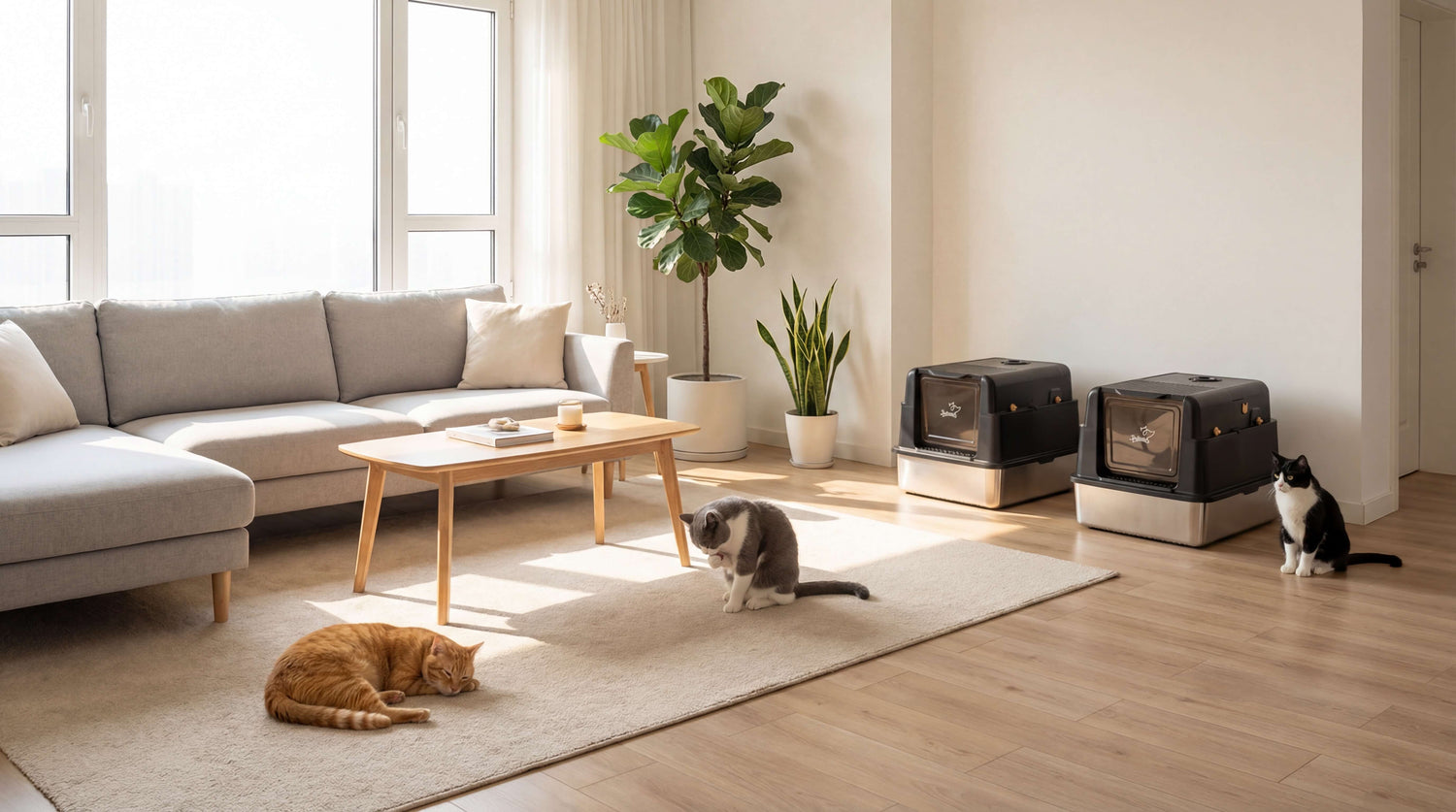
If you share your home with more than one feline, you know the "Multi-Cat Math." Two cats don't just produce twice the waste of one—they seem to create a localized weather system of ammonia and dust. You’ve likely tried everything: charcoal filters, expensive "odor-control" litters, and perhaps you even dropped $500 on a self-cleaning automatic box.
But be honest: Does your home still smell like a litter box?
The hard truth is that in a high-traffic cat home, the material of your box matters more than the gadgets inside it. While automation handles the scooping, it doesn't handle the material saturation. Today, we’re breaking down why the search for the best litter box for multi cat household always leads back to one material: medical-grade stainless steel.
1. The Math of Ammonia: Why Multi-Cat Homes Fail the Sniff Test
In a single-cat home, a plastic litter box might take two years to become "permanently stinky." In a three-cat home, that timeline shrinks to less than six months.
H3: The Saturation Point
Every time a cat uses a plastic box, their claws leave micro-scratches. In a multi-cat household, the sheer volume of digging means these scratches accumulate at lightning speed. These fissures trap urine, which then breaks down into ammonia. Because cats are territorial, they often "over-bury" or dig deeper in communal boxes, accelerating the destruction of the plastic surface.
H4: The Territorial Scent Trap
Cats use scent to communicate. If a litter box retains the smell of "Cat A" due to the porous nature of plastic, "Cat B" may feel the need to mark the area more aggressively. This cycle leads to higher urine volume and, eventually, litter box avoidance.
2. The Myth of the Automatic Litter Box
Automatic boxes are a miracle of convenience, but they have a fatal flaw for multi-cat owners: Plastic interiors and complex joints.
H3: The "Odor Sponge" Effect
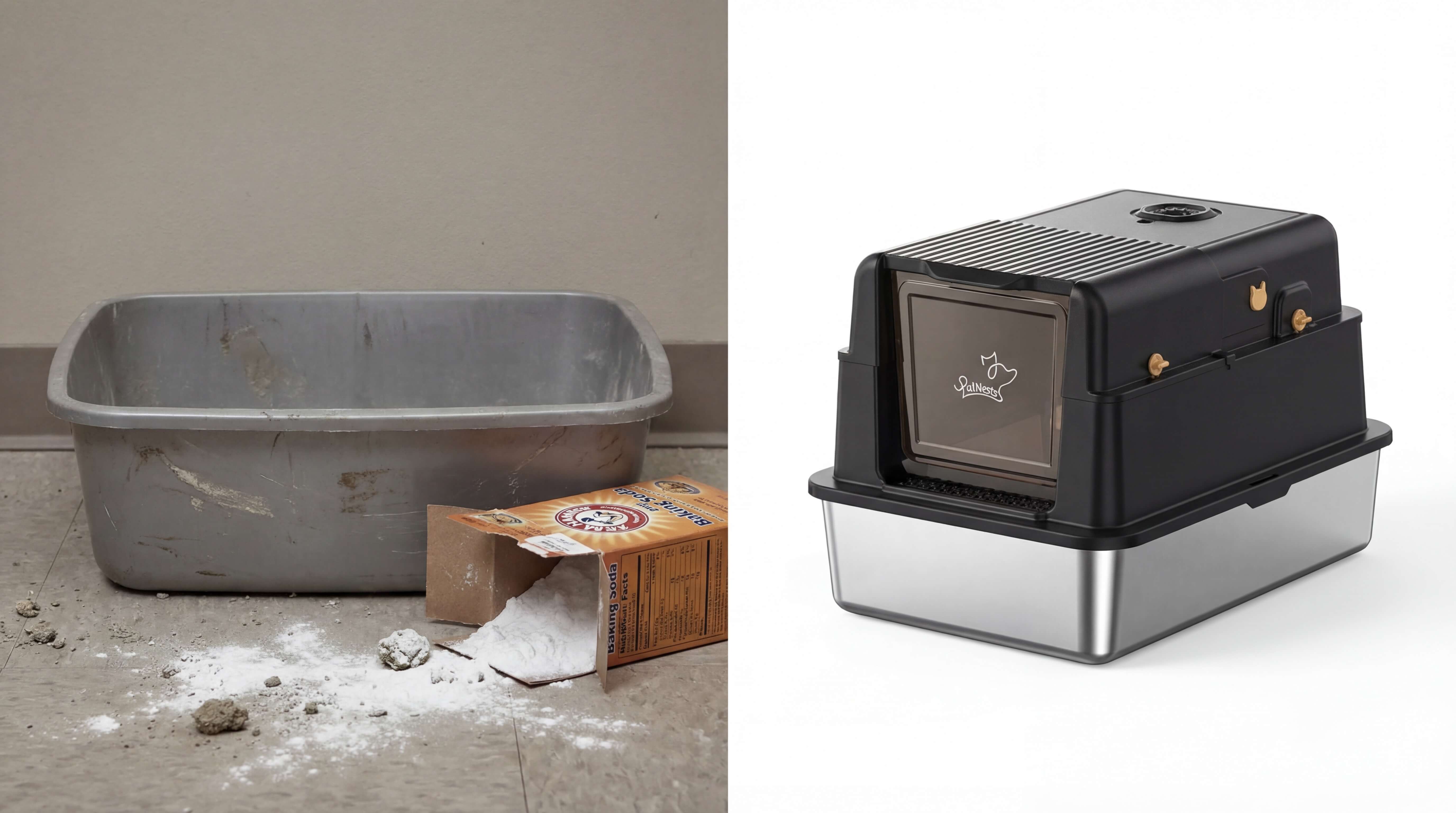
Most automatic boxes are made of molded plastic. While the globe rotates to remove clumps, the interior walls are constantly brushed by soiled litter. Over time, the plastic absorbs the odors. You can’t throw a $500 machine in the backyard and hose it down with boiling water—but you can with a stainless steel tray.
H4: The "Diarrhea Disaster"
Any multi-cat parent knows that if one cat has an upset stomach, an automatic box can turn a small mess into a mechanical nightmare, spreading waste across sensors and gears. A large, open high-capacity stainless steel tray provides a stable, easy-to-sanitize environment that doesn't break down when things get messy.
3. Finding the Best Litter Box for Multi Cat Household
When you have multiple cats, you need three things: Space, Durability, and Zero Absorption.
H3: Why Size Matters (The XL Factor)
The best litter box for multi cat household must be large enough for the biggest cat to turn around comfortably. Many automatic boxes have surprisingly small interior footprints. A large stainless steel box (like the PalNests XL) offers 20-30% more usable surface area than most enclosed options, reducing the "crowding" stress that leads to inter-cat tension.
H4: The N+1 Rule
Behaviorists recommend having one more box than you have cats. If you have 3 cats, you need 4 boxes. Buying 4 automatic boxes is financially impossible for most. However, creating a "Station" with high-quality stainless steel boxes ensures that even if one is occupied, the others remain pristine and odor-free.
4. Why Stainless Steel is the Heavy-Duty Hero
H3: Non-Porous Surface: The Ammonia Killer
Stainless steel is chemically incapable of absorbing odors. In a multi-cat home, this is your secret weapon. No matter how many times the box is used, the urine stays on top of the material until it is clumped or cleaned. It never sinks in.
H4: Hygiene at Scale
With multiple cats, the risk of cross-contamination (like parasites or UTIs) is higher. Stainless steel can be deep-cleaned with boiling water or medical-grade disinfectants without degrading. It is the only material that allows you to "reset" the hygiene level to 100% every single time you wash it.
5. Quick Takeaways: Multi-Cat Success
● Ditch the Plastic: In multi-cat homes, plastic reaches its "odor saturation point" 3x faster.
● Prioritize Material: A non-porous surface is more effective at odor controlthan any electronic fan or filter.
● Apply the N+1 Rule: Use durable stainless steel boxes to cost-effectively manage the "one box per cat plus one" requirement.
● Easy Maintenance: Choose boxes that can handle a "hose-down" to prevent bacteria buildup.
● Invest in XL: High-traffic boxes need more surface area to prevent litter saturation.
Conclusion: Reclaiming Your Home
Living with multiple cats is a joy, but living in a home that smells like a kennel is a choice. You don't need more gadgets; you need better materials. By switching to the best litter box for multi cat household—a high-capacity, medical-grade stainless steel system—you are removing the "odor sponge" from your home.
It’s time to stop the cycle of buying, smelling, and tossing. Invest in a solution that can handle the load.
FAQ: Multi-Cat Management
Q: Can I use an automatic box alongside a stainless steel one? A: Absolutely! Many PalNests customers use an automatic box for convenience but keep 2-3 stainless steel boxes as "anchor stations" to handle the heavy urine load that typically kills automatic box motors.
Q: How often should I wash the box in a 3-cat home? A: We recommend a full wash every 2 weeks. Because it’s stainless steel, a quick spray with a hose and a wipe with mild soap takes less than 5 minutes.
Q: Do cats fight over stainless steel boxes more? A: Actually, less! Because the material doesn't hold "territorial scents," cats tend to view the box as a neutral resource rather than a space owned by the dominant cat.
Q: What litter is best for multi-cat stainless steel boxes? A: Any high-clumping litter works perfectly. Because the steel is smooth, clumps slide off easily without sticking to the bottom.
Q: Is the XL size too big for small apartments? A: It's actually a space-saver. One high-functioning, odor-free XL box is better than three smelly small ones.


Leave a comment
This site is protected by hCaptcha and the hCaptcha Privacy Policy and Terms of Service apply.