
Introduction
If you live with more than one cat, you’ve probably asked yourself this question at least once:
“Why are they fighting so much? Do they need more space?”
In multi-cat homes, conflict rarely comes from “bad behavior.”
More often, it’s a space design problem — especially when vertical territory is missing or poorly planned.
Cats are not pack animals. They are territorial negotiators.
When resources like resting spots, escape routes, or observation points are limited, tension builds fast.That’s where a well-designed cat tree for multiple cats becomes more than furniture — it becomes a peacekeeping system.
In this guide, we’ll break down:
● Why multi-cat homes need a different cat tree strategy
● What features actually reduce fighting (and which ones don’t)
● How to set up a shared cat tree so cats can coexist — not compete
This is not a product roundup.
It’s a setup guide designed to stop conflict before it starts.
Why Multi-Cat Homes Need a Strategic Cat Tree Setup
Understanding Feline Territory & Social Behavior
Cats define territory in three dimensions, not two.
While humans think in floor plans, cats think in:
● Height
● Visibility
● Access control
In the wild, vertical space allows cats to:
● Observe without engaging
● Retreat without confrontation
● Signal status without fighting
In a home with multiple cats, removing vertical options forces cats to negotiate territory on the floor — where conflict is unavoidable.
A cat tree isn’t about climbing.
It’s about choice.
Common Conflict Triggers in Multi-Cat Households
Most fights are triggered by:
● One cat blocking access to a preferred spot
● Forced proximity with no escape route
● Competition over sleeping or scratching areas
A single, poorly designed cat tree can actually increase tension if:
● It has only one top perch
● Entry points are narrow
● Platforms force cats to pass each other
That’s why setup matters more than size.
What a Cat Tree Does That Floor Space Cannot
A proper cat tree:
● Creates parallel territories
● Allows cats to avoid each other without retreating to another room
● Reduces stress signals like staring, stalking, and ambushing
In multi-cat homes, vertical territory = emotional buffer.
Core Features of a Cat Tree for Multiple Cats
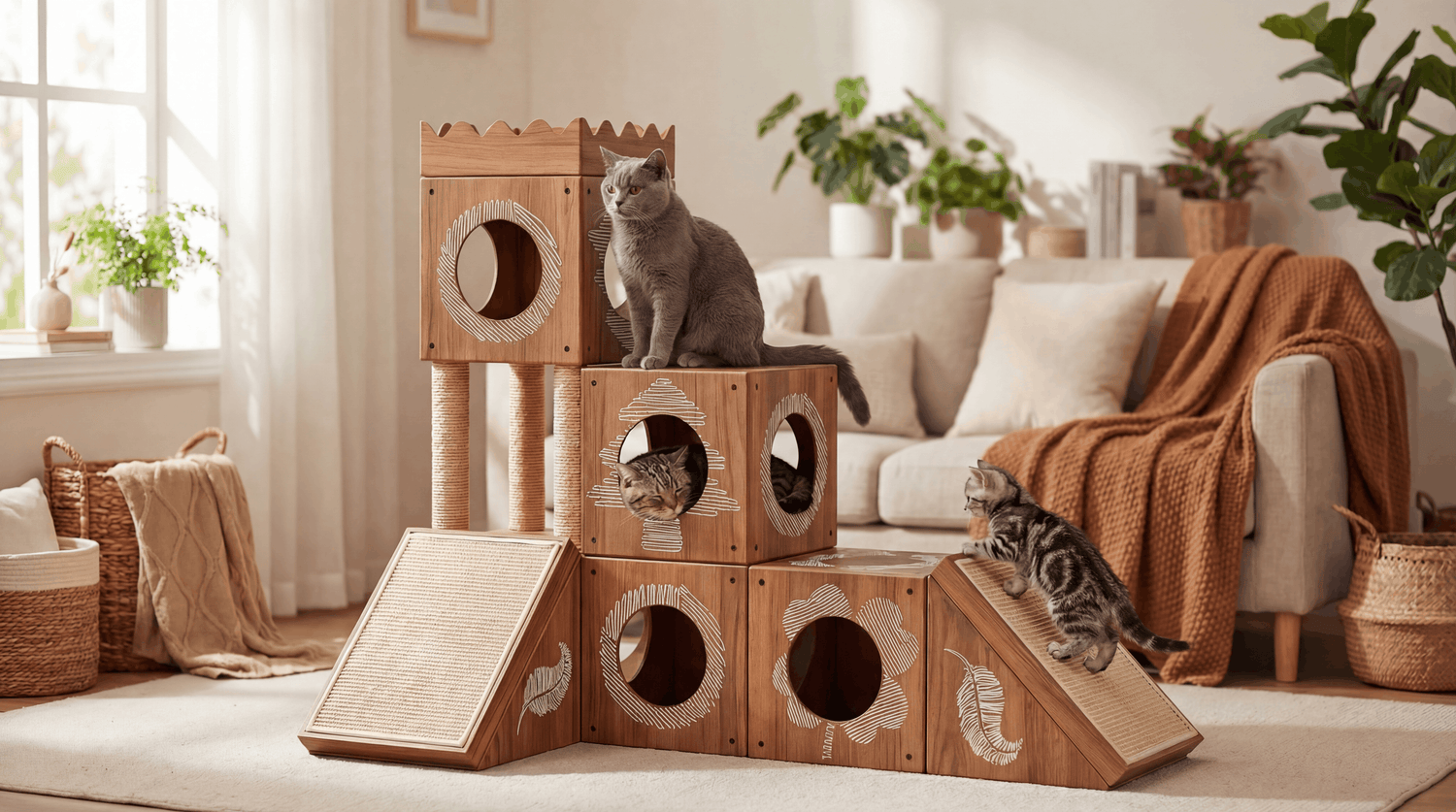
Multiple Levels & Platforms
A multi-cat cat tree should offer:
● At least one level per cat, plus one extra
● Platforms at different heights, not stacked too closely
Why?
Cats use height to establish preference, not dominance.
High Perches vs Mid Shelves vs Low Hubs
● High perches → confident or senior cats
● Mid shelves → neutral shared zones
● Low hubs → shy or younger cats
This vertical zoning reduces competition naturally.
Multiple Sleeping & Hiding Zones
If cats must share a tree, they must be able to:
● Rest without being seen
● Enter and exit without crossing paths
Look for:
● More than one enclosed cubby
● Open platforms paired with semi-covered areas
Privacy is not optional in multi-cat homes.
Integrated Scratch Surfaces
Scratching is territorial communication, not just nail care.
A good cat tree for multiple cats should include:
● Multiple scratch posts
● Different orientations (vertical + angled)
This prevents:
● Resource guarding
● One cat “claiming” the tree via scent
Stability & Weight Capacity
Instability creates anxiety.
If one cat jumps and the tree shakes:
● Other cats will avoid it
● Or guard it aggressively
For multi-cat homes, stability is a behavioral requirement, not a safety bonus.
Easy Access Entry & Exit Points
Avoid:
● Single-ladder designs
● Narrow choke points
Choose setups with:
● Open sides that allow visual awareness
Cats hate surprises — especially from behind.
How to Set Up a Cat Tree for Multiple Cats
Choosing the Right Room
Ideal placement:
● Shared living area (not isolated)
● Near natural light
● With sightlines to windows or room entrances
Avoid tight corners where cats can feel trapped.
Balancing Vertical & Horizontal Territory
A common mistake:
“I bought a tall tree, that should be enough.”
Height alone isn’t balance.
Combine:
● Vertical height (cat tree)
● Horizontal options (wall shelves, nearby furniture)
This allows cats to reroute instead of confront.
Avoiding Bottleneck Points
Never place:
● Food bowls
● Litter boxes
● Or narrow hallways
directly next to the cat tree.Cats exiting the tree should never be forced into contact.
Creating Alternative Routes
If possible:
● Pair the cat tree with wall perches
● Or place a second vertical element nearby
Two routes = zero ambushes.
Multi-Cat Peace Strategies Beyond the Tree
Distributed Scratching Posts
Rule of thumb:
One scratch zone per cat, plus one extra.
This prevents:
● Territorial marking conflicts
● Stress scratching elsewhere
Supplemental Vertical Space
Even the best cat tree can’t do everything.
Add:
● Window perches
● Floating shelves
● Tall furniture cats are allowed to use
Think in systems, not single items.
Behavior Encouragement Techniques
Encourage shared use with:
● Treat placement on different levels
● Calm play sessions around (not on) the tree
Never force co-use.
Resource Zoning
Food, water, litter, rest — all should be spatially separated.
A calm home is a well-zoned home.
Day-to-Day Use: How Multiple Cats Share a Tree
Sleeping Patterns & Hierarchy
Cats self-organize.
● Given enough options, they:Rotate spots
● Avoid confrontation
● Establish time-based sharing
Conflict usually means insufficient options, not dominance issues.
Play, Jump & Chase Paths
Healthy play looks like:
● Leap → chase → disengage
Unhealthy play becomes:
● Cornering
● Blocking exits
Good tree design supports escape, not pursuit.
Stress Reduction Through Choice
Choice reduces cortisol.
Vertical choice reduces conflict.It’s that simple.
Case Examples
Two-Cat Homes
● One main tree
● One secondary vertical element
Three or More Cats
● Two trees or one modular + wall system
● Clear zoning per room
Mixed Personality Cats
● Balance open and enclosed zones
● Respect shy cats’ need for invisibility
Expert Tips
Observe & Adjust
Watch:
● Who avoids the tree
● Who guards it
Adjust layout, not cats.
When to Add a Second Tree
If:
● One cat never uses it
● Or fights persist
Add space, not discipline.
Quick Takeaways
● Multi-cat conflict is usually a space design issue
● A cat tree for multiple cats must offer choice, not just height
● Stability, access routes, and zoning matter more than size
● One tree is part of a larger vertical system
● Peace comes from options, not enforcement
Conclusion
If your cats are fighting, the answer is rarely “more toys” — and almost never “punishment.”
It’s better space.
A thoughtfully designed cat tree for multiple cats:
● Reduces competition
● Supports natural avoidance
● Turns shared territory into parallel territory
When cats don’t have to negotiate every interaction, harmony follows.
If you’re designing or upgrading your setup, think like a cat:
Can I see? Can I escape? Do I have a choice?
Answer yes — and the fighting usually stops.
FAQs
Q1: Is one cat tree enough for multiple cats?
Sometimes — if it offers enough platforms and exits. Otherwise, add vertical supplements.
Q2: Why do my cats fight on the cat tree?
Usually due to bottlenecks, limited perches, or instability.
Q3: How tall should a cat tree be for multiple cats?
Tall enough to create levels — but layout matters more than height.
Q4: Do cats really share cat trees?
Yes, when given enough choice and escape routes.
Q5: Should I separate cats instead of adding space?
Separation treats symptoms. Space design treats the cause.



Leave a comment
This site is protected by hCaptcha and the hCaptcha Privacy Policy and Terms of Service apply.