
Feline obesity is the most common preventable disease in North American cats. While "chonky" cats are internet sensations, the medical reality is sobering: an extra two pounds on a cat is equivalent to nearly thirty pounds on a human. It leads to diabetes, joint pain, and a decreased quality of life.
The biggest obstacle to weight loss isn't a lack of love—it's a lack of precision. Manual measuring cups are notoriously inaccurate, often leading to a 15-20% caloric surplus. To truly help your cat, you need a system that removes human error.
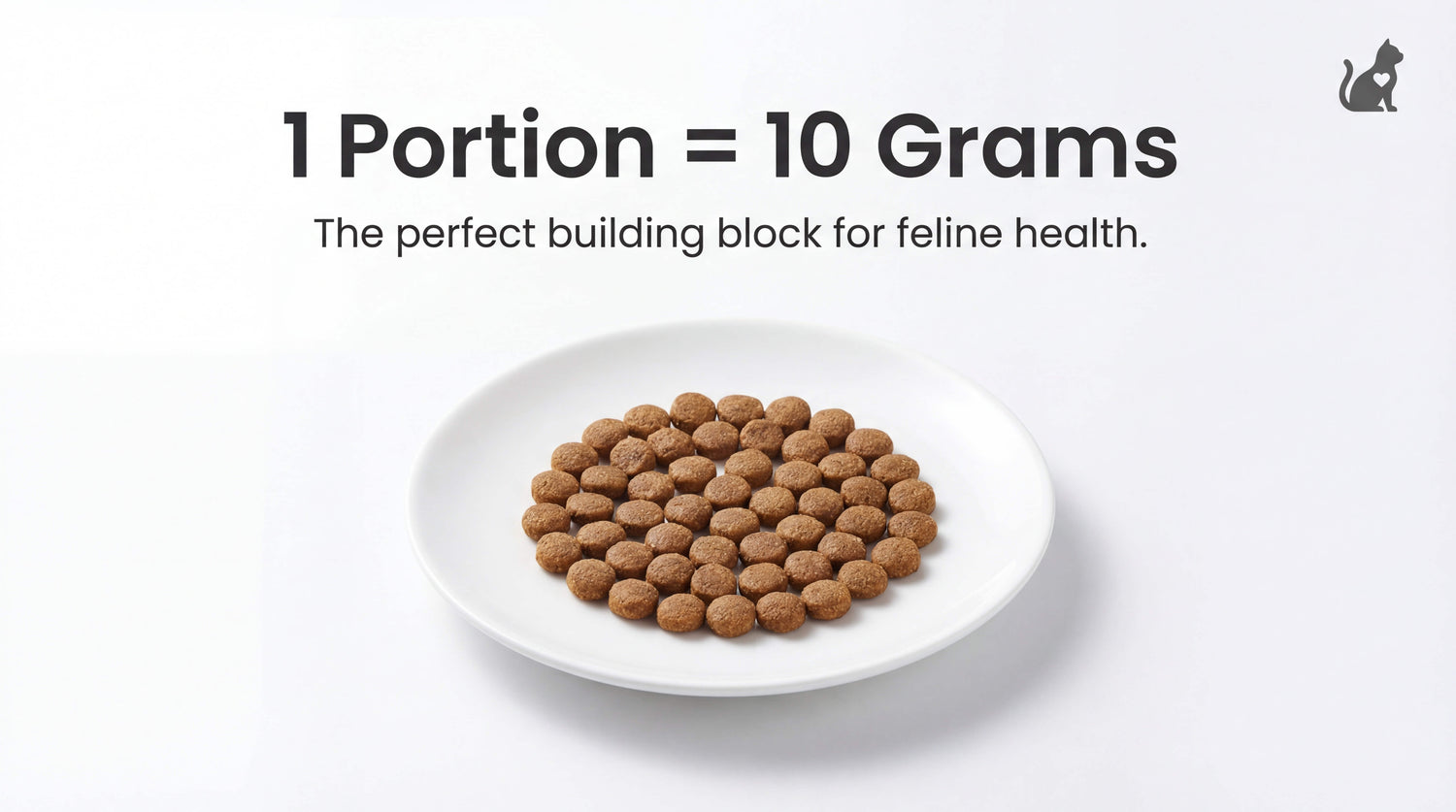
By utilizing an automatic feeder for cat weight loss that operates on a strict 1 portion = 10g logic, you can transform your cat’s health in just 21 days.
The Failure of the Scoop: Why Manual Feeding Ruins Diets
Most pet parents "eyeball" the food. Unfortunately, kibble density varies by brand and even by batch. A "half-cup" of one brand might be 50g, while another is 65g.
In a weight management plan, portion control for cats is the only way to ensure a caloric deficit. The PalNests PN-CF01 solves this by dispensing in standardized 10g increments. This allows you to treat your cat's nutrition like a prescription—accurate, consistent, and effective.

Phase 1 (Days 1-7): Calibration & Calorie Math
The first week is about establishing a scientific baseline. You cannot manage what you do not measure.
Calculating the RER
Before setting your feeder, you must determine your cat’s Resting Energy Requirement (RER). Use this formula for their target weight:
$$RER = 70 \times (\text{target body weight in kg})^{0.75}$$
Setting the 10g Baseline
Once you have the daily calorie count, divide it by the calories per gram of your food (found on the bag).
● Example: If your cat needs 200 calories and the food is 4 kcal/gram, they need 50g per day.
● The PalNests Setup: Program the app for 5 portions (10g each) distributed throughout the day.
Phase 2 (Days 8-14): The Stealth Transition
By week two, your cat may become vocal about their new boundaries. This is where the Dual-Hopper technology becomes your greatest ally.
Mixing Diets Without Digestive Upset
Switching to a "Weight Management" kibble too quickly can cause diarrhea or food refusal. Use the dual bins to your advantage:
● Bin A (Left): Current favorite kibble.
● Bin B (Right): New low-calorie diet food.
Slowly shift the portion ratio in the App from 100% Bin A to 100% Bin B over seven days. Because the PalNests dispenses in 10g units, the transition is incredibly smooth.
Managing "The Begging Phase"
Instead of two large meals, use the App to schedule 6 to 8 tiny 10g meals. Frequent feeding keeps blood sugar stable and prevents the "starvation panic" that leads to incessant meowing.
Phase 3 (Days 15-21): Metabolic Stabilization
During the final week, the focus is on consistency. Your cat’s metabolism is beginning to adjust to the new caloric intake.
At this stage, the automatic feeder for cat weight loss acts as the "Bad Cop." Your cat will stop associating you with the restriction of food and start seeing the machine as the source of the schedule. This preserves your bond while the PalNests handles the discipline.
Summary: Quick Takeaways
● Standardized Portions: 1 portion always equals 10g in the PalNests system.
● Micro-Meals: Feed 5-8 times per day to prevent hunger-induced begging.
● Dual-Hopper Transition: Use two bins to swap food types without stomach upset.
● Scientific Deficit: Calculate calories based on target weight, not current weight.
● Bond Preservation: Let the feeder be the "timer," and you be the "playmate."
Conclusion: Investing in More Years of Purrs
Weight loss is the kindest thing you can do for an overweight cat. It isn't about deprivation; it's about precision. By switching to a system that honors the 10g portion rule, you are taking the guesswork out of their survival.
The PalNests PN-CF01 provides the technology, but your commitment to the 21-day plan provides the results. Watch for the signs of success: more energy, a sleek coat, and a renewed zest for life. A healthier tomorrow starts with a 10g portion today.
FAQ: Weight Loss & Portions
Q: Does every kibble type weigh exactly 10g per portion?
A: Because the feeder dispenses by volume, very light or very heavy kibble may fluctuate by ±1-2g. For maximum accuracy, we recommend weighing one dispensed portion on a kitchen scale when you switch food brands.
Q: Can I set a 15g meal?
A: The feeder dispenses in 10g units. To achieve a 35g daily average, you can alternate between 3 portions (30g) and 4 portions (40g) across your scheduled meals.
Q: What if my cat eats too fast even with 10g portions?
A: The PalNests stainless steel bowl is wide enough to accommodate "slow-feeder" inserts if your cat is an extreme "speed-eater."
Q: Does the app track total calories?
A: The App tracks the number of 10g portions dispensed. You can use the "Feed Record" to verify exactly how many grams your cat consumed each day.
Q: Is the child lock necessary for weight loss?
A: Yes! Smart cats will try to press the manual feed button to get extra 10g snacks. Hold the Lock button for 3 seconds to ensure they can't "hack" their diet.


Leave a comment
This site is protected by hCaptcha and the hCaptcha Privacy Policy and Terms of Service apply.