
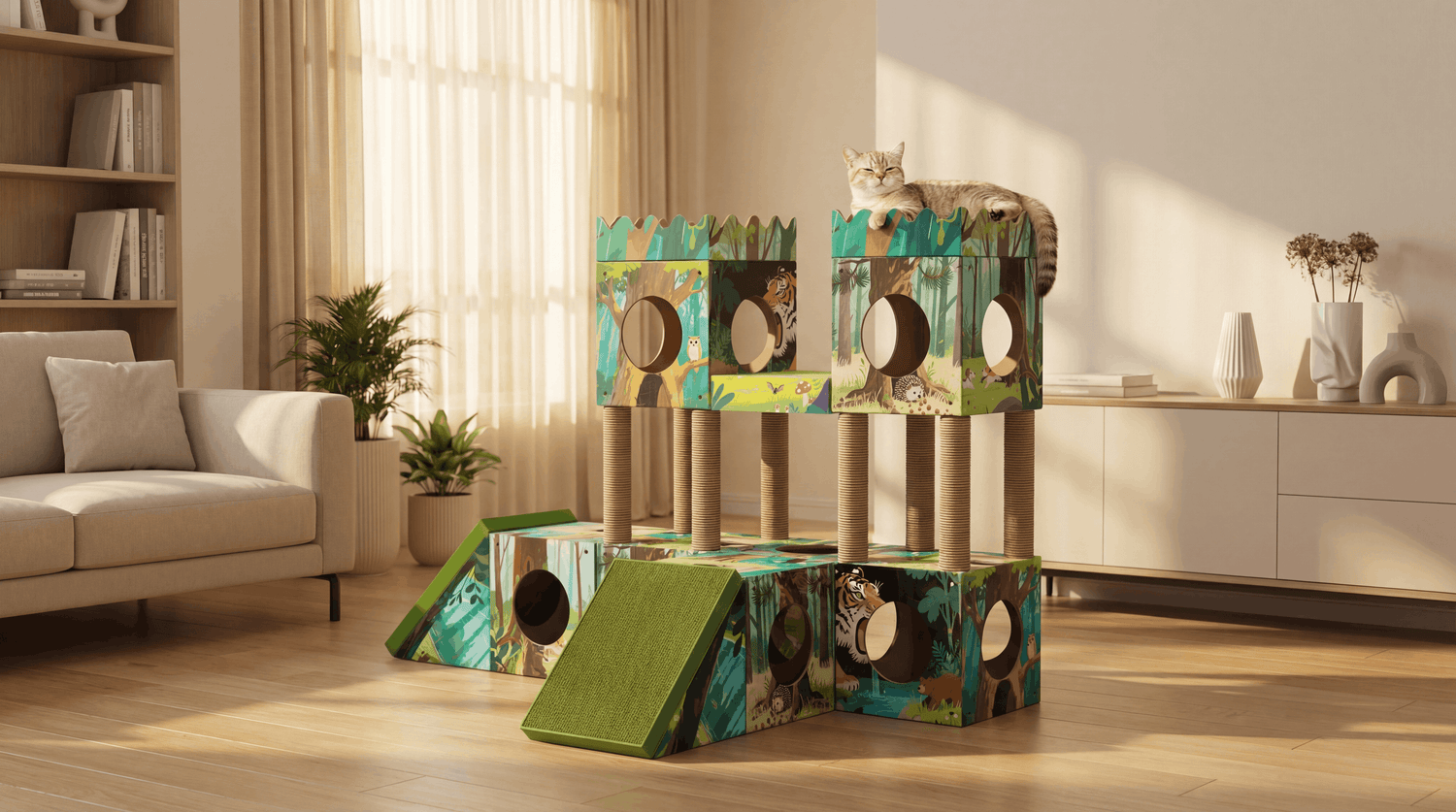
If you’ve ever stared at a cat tree and wondered, “Is this really worth the money?” — you’re not alone.
Introduction: The Question Every Cat Owner Asks
Are cat trees worth it?
It’s one of the most searched — and most emotionally loaded — questions among indoor cat owners.
On one side, you see glowing reviews claiming cat trees are “life-changing.”
On the other, you worry it might become another bulky, expensive item your cat ignores completely.
This hesitation makes sense. A cat tree isn’t cheap, isn’t tiny, and isn’t something you can “return” emotionally once it’s in your living room.
So instead of asking “Are cat trees good?”, this article answers a better question:
What actually changes after 30 days of owning a cat tree?
Using a realistic week-by-week timeline, we’ll break down:
● What changes do happen
● What changes don’t
● When a cat tree is truly worth it — and when it’s not
If you’re an indoor cat owner sitting on the fence, this guide is for you.
Before Buying: Why People Doubt Cat Trees Are Worth It
Most hesitation comes from three very rational fears.
“What if my cat doesn’t use it?”
Cats are famously unpredictable. Many owners worry their cat will sniff it once… and never return.
“It’s expensive for something optional”
Food, litter, vet bills — those are non-negotiable. A cat tree feels like a luxury, not a necessity.
“I don’t want another unused item in my home”
Especially for apartment dwellers, wasted space equals wasted money.
These doubts aren’t wrong — but they often come from misunderstanding how cats actually use vertical space over time.
What “Worth It” Really Means for Cat Owners
A cat tree isn’t “worth it” because it looks cute or checks a box.
It’s worth it if it creates measurable daily improvements.
Here’s how value actually shows up:
● Less furniture damage → redirected scratching
● Less attention-seeking behavior → independent stimulation
● More predictable routines → calmer household
● Improved indoor enrichment → healthier mental state
The key is not instant excitement, but habit formation.
Week 1 (Days 1–7): The Adjustment Phase
This is where many owners panic.
Your cat may:
● Sniff the cat tree
● Sit near it, not on it
● Ignore it entirely
This is normal.
Cats don’t “test” new objects — they observe them safely first.
Common Week 1 Mistakes
● Moving the cat tree repeatedly
● Forcing the cat onto it
● Declaring it “a waste” too early
A cat tree is being mapped, not rejected.
Week 2 (Days 8–14): Habit Formation Begins
Something subtle changes.
You’ll notice:
● A preferred level or platform
● Short naps instead of full sleep
● More frequent casual use
This is when owners often realize:
“Oh… my cat has been using it. Just quietly.”
This phase answers the question “Will my cat use a cat tree?” — usually with a yes.
Week 3 (Days 15–21): Behavioral Shifts Appear
Now the benefits become obvious.
What Often Improves:
● Scratching moves away from furniture
● Energy gets released vertically
● Zoomies become shorter and less destructive
For indoor cats, a cat tree becomes:
● A lookout
● A scratch zone
● A personal territory
This is where long-term value starts to form.
Week 4 (Days 22–30): Long-Term Value Sets In
By now, the cat tree is no longer “new.”
It’s part of the home.
Owners often report:
● Cats choosing the tree over couches
● Less nighttime disturbance
● More independent play
This is the moment most people stop asking “Is it worth it?” — because the answer feels obvious.
What Changes You Should NOT Expect
To stay honest, here’s what cat trees don’t magically do:
● They won’t make an aggressive cat friendly
● They won’t replace playtime
● They won’t fix poor placement or bad design
A poorly designed cat tree can still be a waste.
When a Cat Tree Is NOT Worth It
A cat tree may not be worth it if:
● It’s unstable or poorly constructed
● It doesn’t fit your home layout
● It lacks scratching-friendly surfaces
● It overwhelms small living spaces
Design and material quality matter — a lot.
Cat Tree vs No Cat Tree: A 30-Day Comparison
|
Aspect |
With Cat Tree |
Without Cat Tree |
|
Scratching |
Redirected |
Random furniture |
|
Energy |
Vertical release |
Zoomies |
|
Territory |
Clear zones |
Conflict |
|
Owner Stress |
Lower |
Higher |
This comparison is why many owners later say:
“I wish I bought it sooner.”
Final Verdict: Are Cat Trees Worth It?
Yes — when chosen correctly.
A well-designed cat tree:
● Serves multiple daily purposes
● Fits your space
● Matches how cats naturally behave
For indoor cats, it’s not a luxury — it’s environmental infrastructure.
If you don’t want bulky, carpet-covered towers, modern options like modular cardboard cat trees offer:
● Lighter visual weight
● Flexible layouts
● Better integration into real homes
That’s where products like the PalNests Cat Tree & Towerstand out — offering both Green and Beige (Natural) color options for style-conscious homes, without sacrificing function.
Quick Takeaways
● Cat trees show value over time, not instantly
● Week 2–3 is where real behavior change appears
● Poor design = wasted money
● Good design = daily improvement
● For indoor cats, vertical space matters
FAQs
Are cat trees really necessary for indoor cats?
Yes. Indoor cats lack natural climbing and observation opportunities.
How long does it take for a cat to use a cat tree?
Most cats show consistent use within 2–3 weeks.
Do cat trees reduce furniture scratching?
Yes — if the scratching surface is appealing and well placed.
Are cardboard cat trees durable enough?
High-density corrugated designs can last surprisingly long.
Is one cat tree enough?
For single cats, usually yes. Multi-cat homes may need modular setups.



Leave a comment
This site is protected by hCaptcha and the hCaptcha Privacy Policy and Terms of Service apply.