
If you've spent more than five minutes on pet forums, you’ve likely seen the horror stories—rumors of cats getting stuck or machines cycling while a kitten is still inside. It’s enough to make any responsible cat parent stick to the old-fashioned plastic scoop. But as we reach 2026, the question "Are automatic litter boxes safe for cats?" has a much more sophisticated answer than it did five years ago.
Modern pet technology has moved beyond simple timers. Today’s high-end self-cleaning units utilize a multi-layered ecosystem of cat safety sensors and structural engineering designed specifically to eliminate human—and machine—error. In this guide, we will pull back the curtain on the "safety brain" of these devices to show you exactly how they protect your feline friends.
The Evolution of Safety: From Early Models to 2026 Innovations
Early automatic litter boxes relied almost exclusively on simple timers. If the timer went off, the machine moved—regardless of who was in the way. In 2026, we have entered the era of Active Safety.
Instead of waiting for a timer, modern machines use a combination of biological and mechanical feedback. This means the device is constantly "asking" itself: Is there a cat nearby? Is the weight correct? Is the rotation path clear? Only when the answer to all three is "Yes" will the cleaning cycle proceed.
The First Line of Defense: Weight & Gravity Sensors
The most fundamental safety feature is the weight sensor, typically located in the base or feet of the unit. These high-precision strain gauges are the same technology found in digital kitchen scales.
How High-Precision Gauges Detect Even the Lightest Kitten
In 2026, sensors have become sensitive enough to detect changes as small as 0.1 lbs. When a cat enters the globe, the increase in weight triggers an immediate lockout of the motor. Even if the machine was mid-cycle, the moment it feels an unexpected weight change, it freezes.
The Importance of Automatic Tare and Calibration
One "fear" users have is: What if the cat enters so slowly the sensor doesn't catch it? Modern software uses Continuous Calibration. The machine constantly monitors the "baseline" weight of the litter. Any deviation from that baseline is treated as a safety event, ensuring that the system is never fooled by a cat sneaking in.
The Invisible Shield: Infrared (PIR) and Laser Sensors
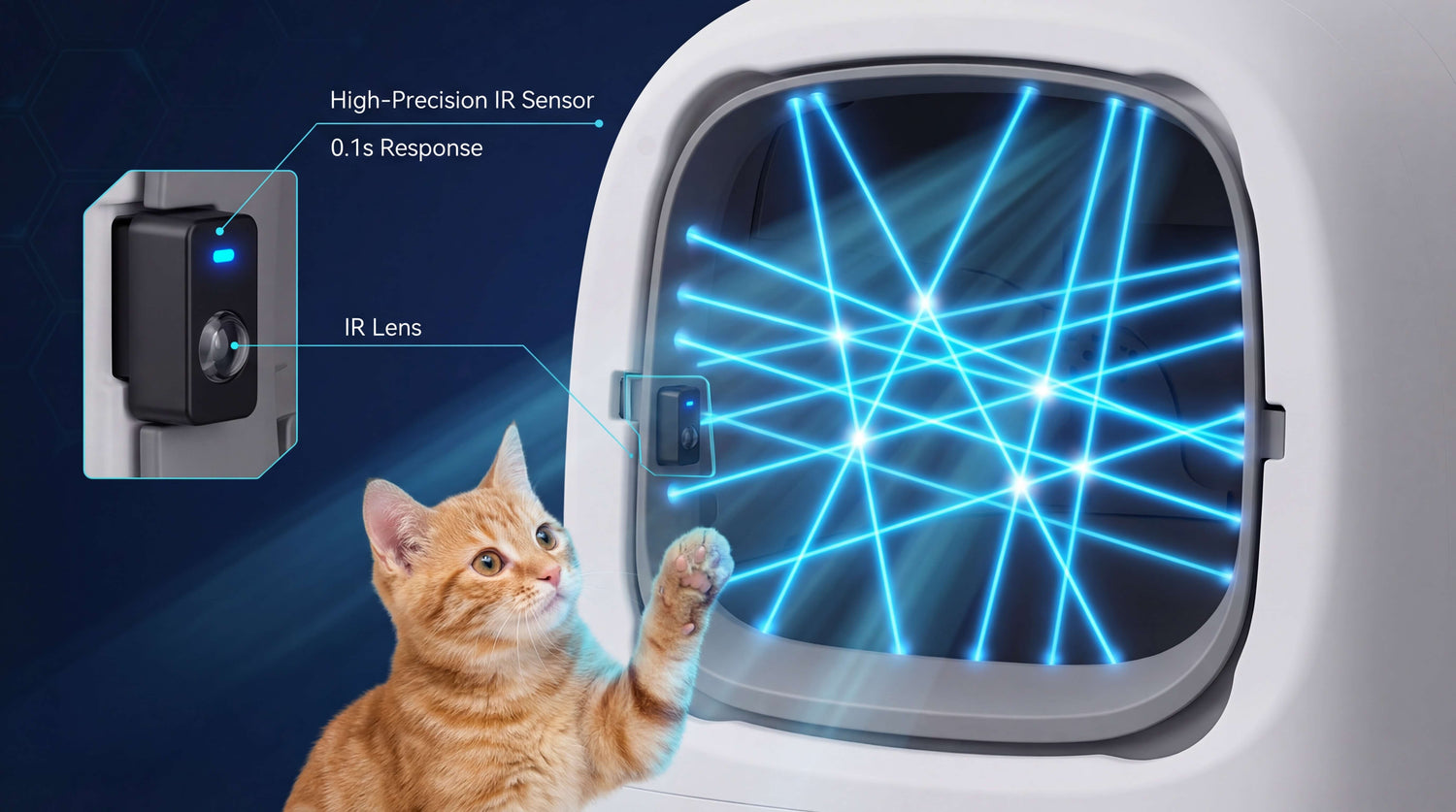
Weight sensors are great, but they have a limit—they only work once the cat is inside. Cat safety sensors using Infrared (IR) technology act as an invisible curtain across the entrance.
These PIR (Passive Infrared) sensors detect the heat signature and movement of a cat before they even touch the litter. If a cat pokes its head into the opening during a cleaning cycle, the IR beam is broken, and the machine stops instantly. In 2026, the best models use Wide-Angle IR Arrays that cover the entire entry perimeter, leaving no blind spots for curious kittens to exploit.
Anti-Pinch Structural Engineering: Design Over Electronics
Electronic sensors can fail, which is why structural design is the "Plan B" that every cat parent should look for. This is often referred to as Anti-Pinch Technology.
The most dangerous design is one that creates a "scissor" or "guillotine" effect where two parts move toward each other. 2026's safest models (like the upcoming PalNests series) utilize an Open-Structure Design. In these models, the waste port and the globe rotation path never create a closing gap. If a cat were to put a paw in an opening, there is no "pinch point" to trap them; the machine simply pushes past or, more likely, triggers a "Soft-Stop" via the motor’s internal resistance sensors.
Unique Insight: The "Soft-Stop" is a 2026 industry standard. It’s a software-encoded torque limit. If the motor feels even a tiny amount of physical resistance (like a stuck toy or a paw), it interprets the spike in electrical current and reverses the motor immediately.
Hall Sensors: Knowing the Exact Position of the Globe
Ever wonder how the machine knows it's "level"? Hall Effect Sensors use magnets to track the exact degree of rotation. If the globe is even 1 degree out of alignment due to an obstruction, the Hall sensors tell the brain to stop. This prevents the machine from trying to "force" its way through a cycle if something isn't right.
What Happens During a Power Outage? Fail-Safe Protocols
A common concern is: Will my cat get trapped if the power goes out mid-cycle?
1. Gravity Fallback: Safely designed globes are weighted so that, in a complete power failure, they don't stop in a position that blocks the cat's exit.
2. App Alerts: In 2026, smart boxes have a small internal capacitor that sends a final "SOS" signal to your smartphone via Wi-Fi if the power is cut, letting you know exactly where the globe stopped.
The Kitten Exception: Why Weight Limits Still Matter
Even with the best cat safety sensors, there is a universal rule: No automatic box is 100% safe for kittens under 3 lbs (approx. 1.4 kg). Why? Because very small kittens may not exert enough pressure on gravity sensors, and their movements can be too erratic for some IR sensors to track reliably. If you have a tiny kitten, always use the machine in "Manual Mode" (power off) until they reach the weight threshold.
Quick Takeaways: The 2026 Safety Checklist
● Redundancy is King: Never buy a box with only one type of sensor. You want Weight + IR + Hall Sensors.
● Open Design: Avoid "closed-bin" models that have sharp-angled waste ports.
● Torque Detection: Ensure the motor has an "auto-reverse" feature when it feels resistance.
● App Updates: Choose a brand that provides "Over-the-Air" (OTA) firmware updates to constantly improve safety algorithms.
● Certification: Look for FCC, CE, and UL certifications for electrical safety.
Conclusion: Peace of Mind in the Era of Smart Pet Care
So, are automatic litter boxes safe for cats? In 2026, the answer is a resounding yes—provided you choose a model built with modern safety protocols. The transition from "dumb motors" to "AI-aware systems" has virtually eliminated the risks associated with early-generation models.
By understanding the work that goes into cat safety sensors and anti-pinch engineering, you can move past the fear and embrace the convenience. Your cat deserves a clean environment, and you deserve a home that doesn't smell like a litter box. With the right technology, you can have both without ever compromising on your pet's well-being.
FAQ: Safety & Sensors
Q1: Can a sensor "wear out" over time?
A: High-quality IR and Hall sensors are solid-state, meaning they have no moving parts and can last for years. However, keeping them dust-free (a quick wipe once a month) is essential for peak performance.
Q2: Will my cat's weight change if I add more litter?
A: Yes, but smart boxes have a "Tare" or "Reset" button. Whenever you add litter, the machine re-calibrates to treat the new weight as "Zero."
Q3: Is the electrical cord safe from "chewers"?
A: Most premium 2026 models come with bite-resistant, braided power cords or hidden cord management to prevent electrical hazards.
Q4: What if my cat jumps on top of the machine?
A: Top-tier models have "Top-Surface Sensors." If weight is detected on the exterior shell, the rotation will stop to prevent the cat from falling or being startled.
Q5: Are the infrared sensors harmful to a cat's eyes?
A: No. These use "Passive" or very low-power "Class 1" infrared, which is completely safe for both human and feline eyes, similar to a TV remote.

Leave a comment
This site is protected by hCaptcha and the hCaptcha Privacy Policy and Terms of Service apply.