
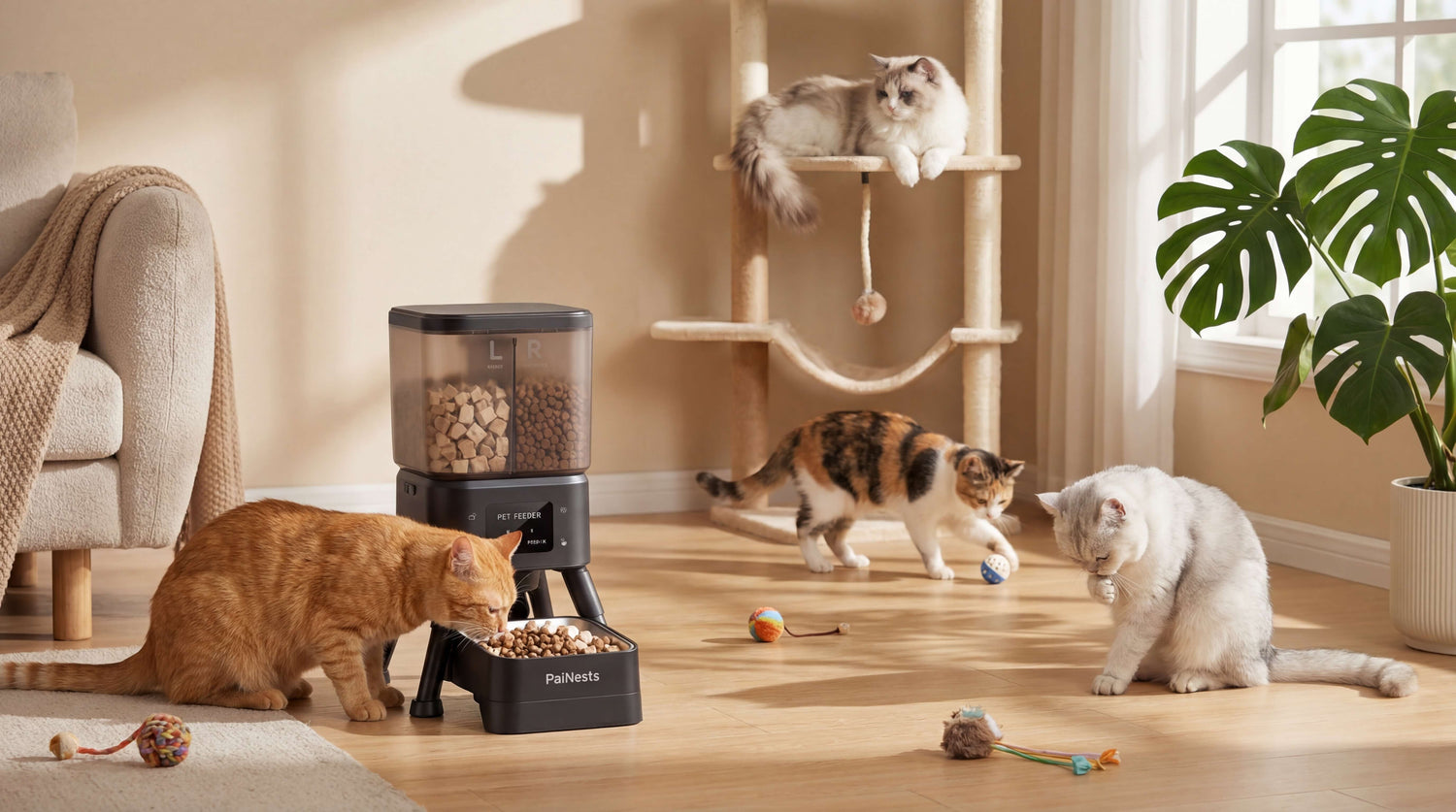
It starts with a growl. Then comes the "shoulder nudge"—the classic move where your dominant cat subtly pushes the timid one away from the bowl. Within seconds, your "Alpha cat" is polishing off a second portion, while your shy eater retreats to the corner, hungry and stressed.
If you live in a multi-cat household, you know the "Mealtime War" all too well. It’s not just noisy; it’s a logistical nightmare that leads to one overweight cat, one underweight cat, and a whole lot of vet bills.
Learning how to feed multiple cats separately is the single most important thing you can do for your pets' health and harmony. In this guide, we’ll break down the psychology of cat food aggression and show you how a modern multi-cat feeding station can end the conflict for good.
The Reality of Multi-Cat Chaos: Why Your Cats Fight Over Food
Cats are solitary hunters by nature. In the wild, they don't share their catch. When we force them to eat side-by-side from the same bowl or even in the same corner, we are often triggering a deep-seated survival instinct called resource guarding.
Understanding Resource Guarding in Cats
Resource guarding happens when a cat perceives that a high-value item (food) is at risk of being taken. This isn't just "being mean"; it’s an anxious response. Even if there is plenty of food, the threat of competition creates tension.
The "Alpha Cat" vs. The "Timid Eater" Dynamics
In most homes, a hierarchy emerges. The bolder cat (the "bully") learns that aggression is rewarded with more food. The timid eater learns that mealtime is scary, which can lead to digestive issues or "bolting" food too fast when they finally get a chance to eat.
The Hidden Dangers of "Free Feeding" in Multi-Cat Homes
Many owners try to solve the problem by leaving a massive bowl of food out all day ("free feeding"). This is a recipe for disaster.
● Feline Obesity: The dominant cat will naturally overeat, leading to diabetes and joint issues.
● Nutritional Neglect: If one cat needs a prescription diet (for kidneys or hairballs) and the other needs kitten food, free feeding makes it impossible to manage their individual health.
● Hidden Illness: When cats share a bowl, you can’t see if one cat has stopped eating—a major early warning sign of illness.
Traditional Solutions (And Why They Often Fail)
Before we look at tech, many people try these manual methods:
1. Feeding in Separate Rooms: This works, but it’s a hassle. Who wants to play "cat usher" three times a day, shutting doors and waiting for everyone to finish?
2. The Microchip Feeder: These are effective but expensive (often $200 per cat) and can be bulky. Plus, some clever "bully cats" learn to swoop in from behind while the lid is still open.
Step-by-Step Guide: How to Create a Strategic Multi-Cat Feeding Station
To truly fix the issue, you need a combination of behavior modification and the right tools.
Step 1: Physical Spacing and Visual Barriers
If your cats are actively fighting, move their feeding spots at least 3-5 feet apart. Using a multi-cat feeding station with a physical divider or splitter can prevent "side-eyeing" during meals, which reduces the urge to guard the food.
Step 2: Transitioning to a Strict Feeding Schedule
Ditch the open bowl. By using a timed cat feeder, you teach your cats that food arrives at a specific time. This reduces "begging" behaviors and creates a routine that lowers overall household anxiety.
Step 3: Utilize Technology to Enforce Boundaries
This is where modern engineering comes in. Instead of two separate machines, a single high-quality feeder with a two-way splitter ensures that both cats get their food at the exact same millisecond.
Why Dual-Chamber Feeders Are a Game Changer for Multi-Cat Parents
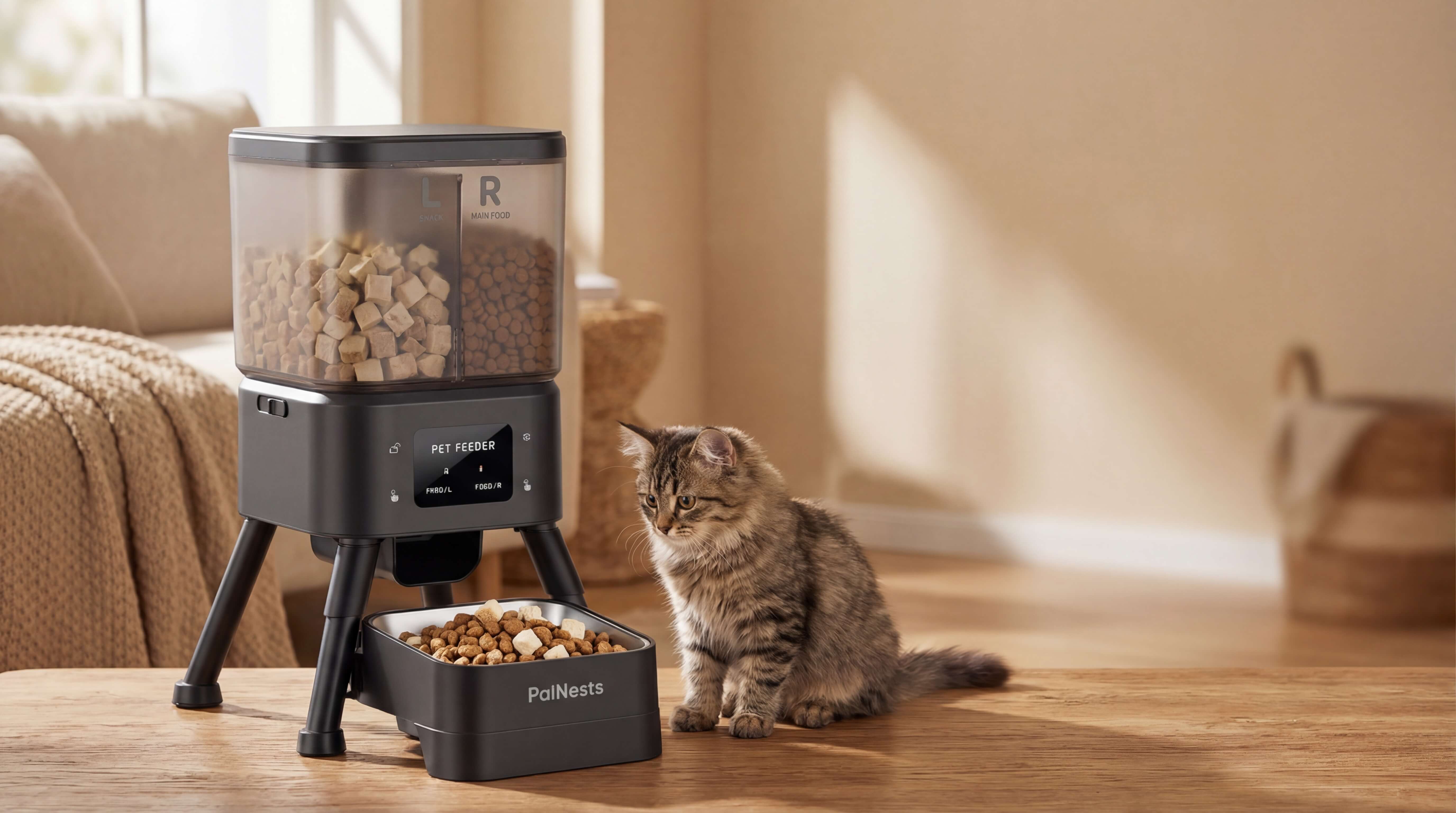
This is the "Secret Sauce" of PalNests. Most automatic feeders have one tank. If you have two cats with different tastes, you’re stuck.
Dual-chamber technology allows you to:
● Synchronize Feeding: Both bowls are filled at the same time, so the "bully cat" is too busy eating their own food to bother the other.
● Custom Portions: Does "Luna" need 15g of diet kibble while "Oliver" needs 20g of high-calorie food? A dual-chamber feeder can dispense these simultaneously into their respective bowls.
The PalNests Advantage: Engineering Peace at Mealtime
We designed the PalNests Dual Chamber Feeder specifically for the multi-cat struggle.
● The Two-Way Splitter: Our precision-engineered splitter ensures an even (or customized) distribution of food into two separate stainless steel bowls.
● Airtight Freshness: Even with two hoppers, the food remains sealed. No more stale bits that cats reject.
● The App Monitoring: You receive a notification the moment the meal is served. If you’re at work, you can check the logs to see if the scheduled meal was successfully dispensed, giving you peace of mind that your timid eater got their share.
Summary: Quick Takeaways
● Resource guarding is a natural instinct that can be managed, not punished.
● Free feeding is the primary cause of obesity and mealtime bullying.
● Separate bowls are a must; a multi-cat feeding station with a splitter is the most space-efficient way to achieve this.
● Simultaneous dispensing prevents the "first cat to the bowl" advantage.
● Dual chambers allow for personalized nutrition in a multi-cat home.
Conclusion: From Chaos to Calm
Ending the "Mealtime War" isn't just about stopping the hissing; it’s about ensuring every cat in your home feels safe and nourished. When you master how to feed multiple cats separately, you’ll notice a shift in your cats' overall behavior. They’ll be calmer, their weights will stabilize, and those 5:00 AM "hunger games" will become a thing of the past.
Investing in a dedicated multi-cat feeding station like the PalNests Dual Chamber Smart Feeder is the ultimate "peace treaty" for your home. You get your sleep back, and your cats get the precise, fresh nutrition they deserve.
FAQ: Stopping the Food Stealers
Q: My dominant cat finishes first and then pushes the other cat away. Help!
A: This is where portion control is key. Try giving the dominant cat a slightly larger portion or using a slow-feeder insert in their bowl to pace them, while the timid cat eats from a standard bowl.
Q: Can I use one PalNests feeder for three cats?
A: Our current dual-bowl system is optimized for two cats. For three or more, we recommend two separate stations placed in different areas of the house to prevent "bottlenecking" at the feeder.
Q: Is it better to feed cats in sight of each other or completely apart?
A: It depends on the level of aggression. For most cats, being in the same room but with a multi-cat feeding station that provides a physical barrier (like our splitter) is enough to create a sense of security.
Q: How do I stop my cat from guarding the automatic feeder?
A: Ensure the feeder is not in a "dead end" or a tight corner. Place it in an open area where the timid cat has multiple exit routes, so they don't feel trapped.
Q: Does the PalNests app allow for different schedules for each chamber?
A: Yes! You can program the ratios and timing for both hoppers, allowing you to tailor the meal exactly to your household's needs.


Leave a comment
This site is protected by hCaptcha and the hCaptcha Privacy Policy and Terms of Service apply.